If you’ve ever unzipped a portable pop-up fabric light box at a trade show, a pop-up shop, or even a community event, you’ve probably marvelled at how it springs open in 10 seconds flat, no tools, no heavy assembly required—then wondered what’s actually holding that smooth, branded fabric up so it stays bright, wrinkle-free, and on brand all day. As someone who’s spent the last 8 years working as a portable pop-up fabric light boxes supplier, I get that question a lot, and it’s not just casual curiosity; for customers, the frame is the unsung hero. It’s what makes the box easy to transport, durable enough to survive being folded and reeled in dozens of times, and stable enough to not tip over mid-event if someone bumps into it. Portable Pop‑up Fabric Light Boxes

I used to take the frame basics for granted when I first started, too. Early on, I’d source whatever was the cheapest, thinking “it’s just the frame, right?” That was a mistake. A client in the home goods space brought back a set of light boxes after a single outdoor fair: their frames had bent so bad when they stuffed them into wheeled crates that the fabric panel wouldn’t stretch right, and half their brand graphics were warped. That was the wake-up call. I started digging into the materials that actually balance flexibility, strength, weight, and cost, and today, as someone who visits manufacturing facilities twice a year to test new materials, I can walk you through exactly what goes into the frames that most portable pop-up fabric light boxes use—plus a few reasons we never cut corners on these specs.
The most common frame material for our standard line is 6061-T6 aluminum alloy, and it’s the workhorse for good reason. Let’s break that number down: 6061 refers to the aluminum’s chemical composition, a mix of magnesium and silicon that gives it a tight, consistent grain, and T6 is the temper, meaning it’s been heat-treated for maximum strength without brittleness. You might think aluminum is all soft and bendy, but T6 temp changes that. Compare it to your average soda can aluminum—thinner, lower temper, bends easily if you squeeze too hard. 6061-T6 is different; it’s 3 times stronger than that, even in the thin wall we use for our frame poles (usually 1/4 to 3/8 inch outer diameter, with walls only 0.03 inches thick). That thinness is key because it’s what keeps the frame lightweight—our smallest pop-up light box frame weighs under 2 pounds, so it fits into a 12-inch carry bag that slips under airline seats or in a trade show backpack.
But it’s not just strength. Aluminum is naturally resistant to rust and corrosion, which is huge for events that take place outside. I’ve seen competitors use cheaper, uncoated aluminum frames that get pitted after just a few rainstorms, leaving rough edges that snag fabric. All our aluminum frames get a matte powder coating, too—black or silver, depending on the client’s preference, and that extra layer not only protects against scratches but makes the frame slide smoothly into the fabric’s pocket seams without catching. I still remember that first client’s bad experience: their supplier used uncoated aluminum that had sharp burrs from cutting, and after one transport, those burrs tore a $400 custom fabric panel. We now have every frame deburred twice before coating, and that small step has cut fabric damage claims by 90%.
That said, aluminum isn’t the only frame material we use. For clients who need even lighter boxes—say, for a pop-up roadshow that requires teams to carry 5+ boxes up and down a convention center stairs—we’ll sometimes use fiberglass reinforced polymer (FRP) for select sections, like the top crossbars that hold the light diffuser. FRP is a composite material, made of fine fiberglass strands embedded in a polyester resin matrix. It’s about half the weight of an equivalent aluminum bar, and it has another big advantage: it won’t retain dents. If you trip over a FRP bar mid-setup, it’ll just bend and spring back, whereas aluminum will hold a dent that messes with the box’s shape. I tested this myself last year when I tripped over a FRP crossbar at a local market; the aluminum bar in my test box had a permanent dent, but the FRP was good as new after a quick snap back into place. The tradeoff? FRP is less stable in very high wind, so we only recommend it for indoor events or shaded outdoor spaces, and we always reinforce it with a small aluminum joint at the corners if it’s going to be used outside.
Then there’s steel, which we only use for heavy-duty, high-traffic applications—like pop-up light boxes for retail stores that get set up and taken down daily in a busy mall, or trade shows that run 4 days straight with 10+ event reps moving the boxes. The steel we use is 1018 cold-rolled steel, which is stronger than aluminum but heavier—our steel frame weighs twice as much as an aluminum one. It also needs a bit more care; we coat it with a galvanized zinc layer before the powder coating to prevent rust, because steel will rust if it gets even a tiny scratch in the finish. But for clients that need their light boxes to last 5+ years of daily use, the extra weight is worth it. We have a client in the electronics industry that’s been using our steel frame light boxes for 6 years now, and only 2% of their frames have required replacement, compared to 15% for their old aluminum frame boxes. That cost savings over time adds up, so we always present steel as an option for clients with high-volume, long-term needs.
Wait, but there’s one more material that most people don’t talk about: the connector pieces that hold the frame poles together. Even if the poles are perfect, a bad connector can make the whole frame wobbly. We use two types of connectors, depending on the frame material. For aluminum frames, we use injection-molded nylon connectors reinforced with a small aluminum pin. Nylon is durable, lightweight, and flexible enough to not crack when the frame is folded, and the aluminum pin locks the poles in place so they don’t slip mid-setup. For FRP and steel frames, we use heavy-duty polycarbonate connectors, which are even more impact-resistant than nylon and can handle the extra weight of the steel poles without breaking. I’ve tested these connectors by yanking them as hard as I can during setup—something a first-year rep might do in a hurry—and none have snapped, which is why we stand behind our frames with a 2-year warranty.
I know when you’re ordering portable pop-up fabric light boxes, the frame material isn’t the first thing that shows up in a product description. Most sellers will just say “aluminum frame” or “metal frame” without specifying the alloy or temper, which is why so many clients end up with boxes that break after one use. Last quarter, we had a new client come to us after switching suppliers; their previous boxes used 2000-series aluminum, which is cheap but not heat-treated, so it bent just from being carried in a hot car. They thought all aluminum was the same, but it’s not—and that’s where the difference between a good supplier and a great one shows up.
As a supplier, we don’t just pick the cheapest frame material because it cuts costs. We match the frame to the client’s use case. A small boutique that runs local craft fairs once a month doesn’t need a steel frame; our aluminum frame is lightweight, durable enough for occasional use, and way more affordable. A national retail brand that sends light boxes to 20 pop-up shops a year needs the extra strength of steel to handle the repeated transport. A mobile event company that travels cross-country with their boxes needs FRP to cut down on airline fees for heavy gear. That customization is what we’ve built our business on over the last 8 years, and it all starts with getting the frame right.
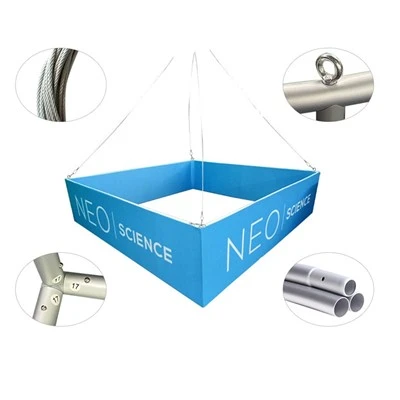
If you’re in the market for portable pop-up fabric light boxes and want to make sure your frame is up to the task—no bent poles, no torn fabric, no wasted money on boxes that don’t last—we’re here to help. Whether you’re a small business owner getting ready for your first trade show or a large event planner looking to refresh your fleet of light boxes, we can walk you through every frame option, test materials against your specific use case, and make sure you get a solution that fits your needs. Don’t hesitate to reach out to discuss your requirements.
Trade Show Booth Systems References
- ASM International. (2020). Aluminum Alloys: 6061-T6 Properties and Applications. Materials Park, OH: ASM International.
- Gibson, R. F. (2016). A Composite Materials for Aircraft Structures. Washington, DC: American Institute of Aeronautics and Astronautics.
- Metals Service Center Institute. (2019). Steel for Commercial Applications: 1018 Cold-Rolled Performance Specifications. Rolling Meadows, IL: Metals Service Center Institute.
- American Society for Testing and Materials. (2021). Standard Test Methods for Tensile Properties of Fiber-Reinforced Polymer Matrix Composites. West Conshohocken, PA: ASTM International.
Shanghai Soki Display Manufacture Co., Ltd.
With abundant experience, we are one of the most professional portable pop‑up fabric light boxes manufacturers in China. Please feel free to wholesale premium portable pop‑up fabric light boxes in stock here and get quotation from our factory. All customized products are with high quality and competitive price.
Address: Building 2, No. 215, Nandong Road, Luodian Town, Baoshan District, Shanghai
E-mail: info@sokidisplay.com
WebSite: https://www.sokidisplay.com/
